Adolf Hitler: The Rise and Fall of the Nazi Dictator
Adolf Hitler remains one of the most consequential and destructive figures in modern history. As the leader of the Nazi Party and the dictator of Germany from 1933 to 1945, his actions precipitated World War II and the Holocaust, fundamentally altering the course of the 20th century. This article examines his life, from his early years in Austria to his ultimate downfall in the bunkers of Berlin.
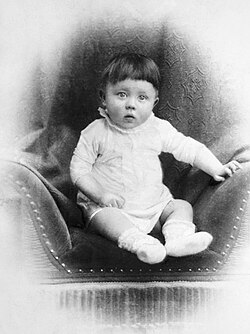
: Hitler (c. 1889–90)
Early Life and Military Service
Born on April 20, 1889, in Braunau am Inn, Austria-Hungary, Hitler's early years were spent in a region that would later become a focal point of historical remembrance. His childhood and education took place in an era of shifting European borders.
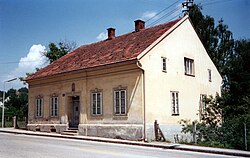
: The house in Leonding, Austria, where Hitler spent his early adolescence
During World War I, Hitler served in the Imperial German Army. He reached the rank of Gefreiter (a private or corporal equivalent) and saw action on the Western Front, including significant engagements such as the First Battle of Ypres, the Battle of the Somme, the Battle of Arras, and the Battle of Passchendaele. His service during this period was a formative experience that influenced his later political ideologies.
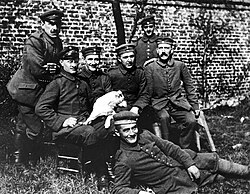
: Hitler (far right, seated) with Bavarian Army comrades from the Bavarian Reserve Infantry Regiment 16 (c. 1914–18)
The Ascent to Political Power
Following the war, Hitler entered the political arena, initially joining the German Workers' Party (DAP) in 1919. He eventually rose to become the leader of the Nazi Party on July 29, 1921. His early attempts to seize power, most notably the Beer Hall Putsch, resulted in his imprisonment in Landsberg.
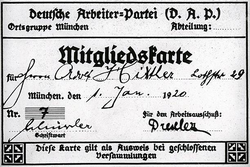
: Hitler's German Workers' Party (DAP) membership card
While in prison, he authored Mein Kampf, a book that outlined his political ideology and future plans for Germany. Upon his release, he focused on rebuilding the Nazi Party and utilizing democratic processes to dismantle the existing political structure.
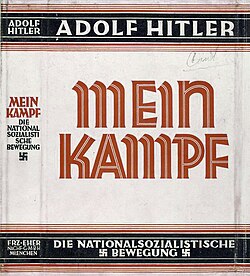
: The dust jacket of Mein Kampf's 1926–28 edition, which Hitler authored in 1925
His rise culminated on January 30, 1933, when he was appointed Chancellor of Germany. Through the use of emergency decrees and the subsequent Enabling Act, he rapidly consolidated power, transforming the German state into a dictatorship under his absolute control as Führer.
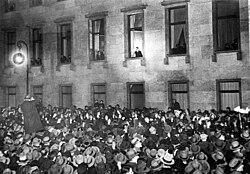
: Hitler, at a window of the Reich Chancellery, receives an ovation on the evening of his inauguration as chancellor, 30 January 1933
The Third Reich and World War II
Under Hitler's leadership, Germany underwent massive rearmament and established new alliances. His foreign policy goals led to the annexation of Austria and parts of Czechoslovakia, eventually triggering the start of World War II with the Invasion of Poland in September 1939.
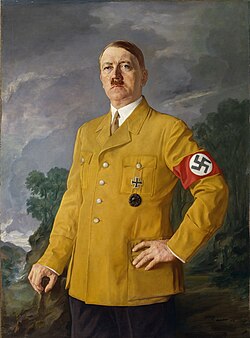
: Portrait by Heinrich Knirr (1937)
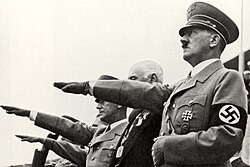
: Hitler and his staff doing a Nazi salute towards the teams during the opening ceremonies of the XI Olympic Games in August 1936
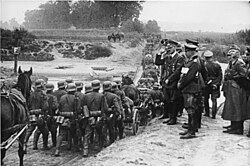
: Hitler reviews troops on the march during the Invasion of Poland, September 1939
As the war expanded, Hitler's decisions drove Germany into conflict with global powers. In December 1941, he announced the declaration of war against the United States, significantly escalating the scale of the conflict.
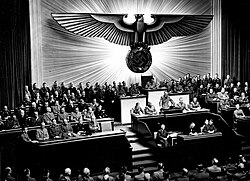
: Hitler announcing the declaration of war against the United States to the Reichstag on 11 December 1941
Defeat and Death
The tide of the war turned against the Nazi regime as Allied forces advanced from both the East and the West. By 1945, the German military situation was collapsing. In his final days, Hitler remained in his command post, the Wolf's Lair, before retreating to Berlin.
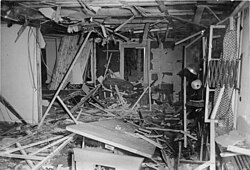
: The destroyed map room at the Wolf's Lair, Hitler's eastern command post, after the 20 July plot
On April 30, 1945, as Allied troops closed in on Berlin, Hitler died from a self-inflicted gunshot wound. His death marked the end of the Nazi regime.
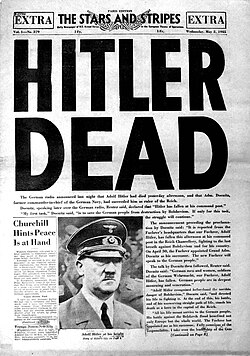
: Front page of the US Armed Forces newspaper, Stars and Stripes, 2 May 1945, announcing Hitler's death. It erroneously states that Hitler died on 1 May; he died on 30 April.
The aftermath of the war revealed the full scale of the atrocities committed under his rule, including the Holocaust, which resulted in the deaths of millions. The liberation of concentration camps, such as Bergen-Belsen, provided the world with evidence of these crimes against humanity.
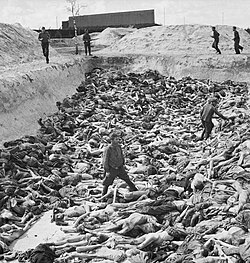
: A mass grave at Bergen-Belsen after the camp's liberation, April 1945
In his personal life, Hitler was accompanied by his long-term partner, Eva Braun, with whom he married shortly before his death.
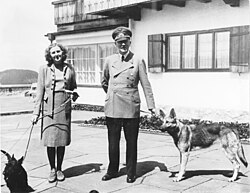
: Hitler and Braun in 1942
Key Facts
- Born: April 20, 1889, in Braunau am Inn, Austria-Hungary.
- Political Roles: Chancellor of Germany (1933–1945) and Führer of Germany (1934–1945).
- Military Rank: Gefreiter in the Imperial German Army during WWI.
- Key Publication: Mein Kampf (authored in 1925).
- Death: April 30, 1945, in Berlin, via self-inflicted gunshot wound.
Summary of Leadership Roles
| Position | Term of Office | Preceded By | Succeeded By |
|---|---|---|---|
| Führer of Germany | 2 August 1934 – 30 April 1945 | Paul von Hindenburg | Karl Dönitz |
| Chancellor of Germany | 30 January 1933 – 30 April 1945 | Kurt von Schleicher | Joseph Goebbels |
| Leader of the Nazi Party | 29 July 1921 – 30 April 1945 | Anton Drexler | Martin Bormann |
![Outside of a building in Braunau am Inn, Austria, where Hitler was born, is a memorial stone placed as a reminder of World War II. The inscription translates as:[437] For peace, freedom and democracy never again fascism millions of dead warn [us]](/images/b0/8b/b08b261a0cdbcd7c09d0247ffbef8fc4563cdd49c5d6e621bf0d493ea44a056a.jpg)
: Outside of a building in Braunau am Inn, Austria, where Hitler was born, is a memorial stone placed as a reminder of World War II. The inscription translates as: For peace, freedom and democracy never again fascism millions of dead warn [us]
Frequently Asked Questions
What was Hitler's rank during World War I?
Hitler served as a Gefreiter in the Bavarian Army during the First World War.
When did Hitler become the Chancellor of Germany?
He was appointed Chancellor on January 30, 1933.
What was the name of Hitler's autobiographical book?
His book, which outlined his political views, is titled Mein Kampf.
How did Adolf Hitler die?
He died on April 30, 1945, in Berlin from a self-inflicted gunshot wound.
Where was Adolf Hitler born?
He was born in Braunau am Inn, Austria-Hungary.