Ad Eundem Degrees in the United States
The ad eundem degree—a Latin term meaning "to the same level"—is a unique academic tradition in the United States. Historically used to recognize qualifications from other institutions, it has evolved into a specialized honorary tradition at a handful of American universities to mark significant career milestones for faculty members.
Key Facts
- Ad eundem degrees were common in colonial-era institutions like Harvard, Yale, and Princeton.
- Historically, these degrees recognized Bachelor of Arts and Master of Arts qualifications from other colleges.
- In contemporary use, three universities (Brown, Lawrence, and Wesleyan) award honorary MAs to professors.
- The timing of the award varies by institution, occurring at tenure, promotion, or retirement.
Historical Use in Colonial America
During the colonial period, several prominent American institutions awarded the ad eundem Bachelor of Arts and Master of Arts as regular academic qualifications to graduates of other universities. This practice allowed institutions to formally recognize the equivalent standing of scholars from different backgrounds.
At Harvard University, while the practice was common throughout the 1700s, these degrees were not specifically recorded as ad eundem until after 1750. Other early adopters included Yale, Columbia, Princeton, and the University of Pennsylvania, with some institutions continuing the practice well into the 19th century.
| Institution | First Documented | Most Recently Documented |
|---|---|---|
| Harvard University | Post-1750 (Common in 1700s) | 1830 |
| Yale University | 1705 | 1879 |
| Columbia University | 1767 | 1770 |
| Princeton University | 1763 | 1884 |
| University of Pennsylvania | Documented | Documented |
| Williams College | 1795 | Documented |
Contemporary Academic Traditions
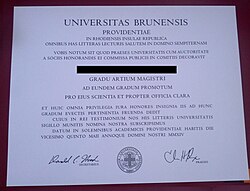
While no longer a standard qualification for general graduates, three universities maintain the ad eundem Master of Arts (MA) as an honorary degree for their professors. Each institution has a distinct trigger for awarding the degree based on the professor's career stage.
Brown University: Tenure and Rank
At Brown University, the ad eundem degree is awarded to faculty members who are granted tenure (a permanent post) and the rank of associate professor. This typically occurs after approximately eight years of service as an assistant professor, though the timeframe may be shorter for those with prior experience at other universities. These degrees are generally presented during the annual May commencement ceremony.
Wesleyan University: Promotion to Full Professor
Wesleyan University confers the ad eundem degree upon faculty who rise to the rank of full professor. There is one specific exception to this rule: professors who already hold a bachelor's degree from Wesleyan as an undergraduate are not awarded a second degree.
Lawrence University: Retirement
At Lawrence University, the degree is awarded upon a professor's retirement. This tradition began in 1934 under college president Henry Merritt Wriston. Having previously served as a professor at Wesleyan and later as president of Brown, Wriston instituted a mandatory retirement age of 65. The ad eundem degrees were originally intended to "soften the blow" for the three faculty members forced to retire under the new policy.
Frequently Asked Questions
What does "ad eundem" mean in an academic context?
Literally meaning "to the same level," it refers to a degree awarded to a person who already holds a similar degree from another institution, effectively recognizing their equivalent status at the awarding university.
Which current US universities still award ad eundem degrees to faculty?
Brown University, Lawrence University, and Wesleyan University continue to use this tradition for their professors.
When does a professor receive an ad eundem degree at Brown University?
They receive it when they are granted tenure and promoted to the rank of associate professor, usually after about eight years of service.
Why did Lawrence University start awarding these degrees at retirement?
President Henry Merritt Wriston introduced the practice in 1934 to provide a gesture of honor to faculty members who were required to retire at age 65.
Do all professors at Wesleyan University receive an ad eundem degree?
No. While it is awarded to those promoted to full professor, alumni who earned their undergraduate bachelor's degree from Wesleyan are excluded from receiving it.