Absent-Minded Professor: The History and Evolution of a Cultural Archetype
The absent-minded professor is a classic stock character—a recurring fictional archetype—typically portrayed as a brilliant scholar whose immense academic talent is contrasted by a struggle to function in everyday life. This character is defined by a tendency toward forgetfulness and social clumsiness, suggesting that their mental energy is so entirely consumed by their research that the physical world becomes a secondary concern.
Psychologically, this trope is often explained in two ways. Some suggest that highly gifted individuals possess unevenly distributed capabilities, meaning they may be geniuses in a specific field while remaining below average in other practical areas. Others argue that the behavior is simply a result of deep immersion, where the scholar becomes so engrossed in their internal world of thought that they lose track of their immediate surroundings.
![Per Lindroth [sv], 1929, Den tankspridde professorn (The Thoughtful Professor)](/images/c8/da/c8da2346a7fdb0b80cba100b071ad54b9e24cd250486086f87f888b75c4aba7b.jpg)
Key Facts
- Definition: A character archetype combining high intellectual brilliance with low practical functioning.
- Distinction: Unlike the "mad scientist," the absent-minded professor is characterized by carelessness and forgetfulness rather than malice.
- Origins: The trope dates back to antiquity, with stories of ancient Greek and Indian philosophers.
- Common Traits: Obsession with research, eccentricity, and a lack of situational awareness.
Historical and Real-World Examples
The concept of the distracted intellectual is not a modern invention. Ancient records describe figures who mirrored this behavior. The Greek biographer Diogenes Laërtius noted that the philosopher Thales of Miletus once fell into a well because he was too busy gazing at the stars to notice where he was walking.
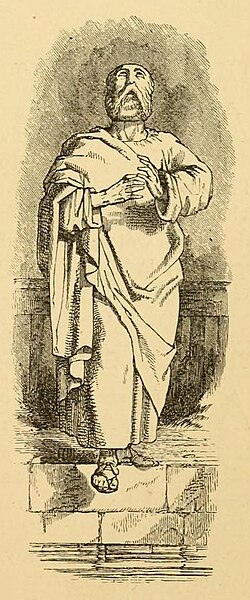
Similarly, the ancient Indian philosopher Akṣapāda Gautama, author of the Nyaya Sutras, was said to be so lost in contemplation that he could not see objects directly in front of him. Legend says the deity Brahmā granted him eyes (akṣa) on his feet (pāda) to help him navigate, giving him the name Akṣapāda.
Throughout history, many renowned scholars have been described as absent-minded due to their intense focus. This list includes foundational figures such as Isaac Newton, Albert Einstein, Nikola Tesla, Archimedes, and Thomas Aquinas. Other noted examples include Adam Smith, André-Marie Ampère, Jacques Hadamard, Sewall Wright, Norbert Wiener, and Pierre Curie. Additionally, William Archibald Spooner—the namesake of the "spoonerism" (a transposition of initial sounds in a phrase)—was well-known for his eccentricity and forgetfulness.
The Archetype in Fiction and Media
In popular culture, the absent-minded professor is frequently a scientist or engineer. In fantasy settings, this role is often filled by a wizard, such as the Disney adaptation of Merlin in The Sword in the Stone or Albus Dumbledore in the Harry Potter series.
Film and Television
The archetype is sometimes blended with the "mad scientist" for comedic effect, as seen in The Nutty Professor or the character Professor Bacterio in Mortadelo y Filemón. Other notable examples include:
- Doc Emmett Brown (Back to the Future): An eccentric scientist-inventor.
- Professor Farnsworth (Futurama) and Professor Frink (The Simpsons).
- Walter Bishop (Fringe) and Professor Von Schlemmer (Adventures of Sonic the Hedgehog).
- Multo (The Zula Patrol).
Literature and Comics
Modern literature began codifying this trope with characters like Jacques Paganel in Jules Verne's 1867 novel In Search of the Castaways. Other literary examples include Professor Branestawm by Norman Hunter, Professor Kokintz in The Mouse That Roared, and the inventor Professor Caractacus Potts from Chitty Chitty Bang Bang.
Comic strips have also embraced the trope through characters such as Professor Calculus (The Adventures of Tintin), Eli Eon (Little Orphan Annie), the Professor in Rupert Bear, and Professor Edgewise in Marvel Family.
Video Games
The trope persists in gaming with characters like Isaac Kleiner (Half-Life), Professor E. Gadd (Luigi's Mansion), and Professor Harold MacDougal (Red Dead Redemption).
Summary of the Archetype
| Feature | Absent-Minded Professor | Mad Scientist |
|---|---|---|
| Primary Trait | Forgetfulness / Distraction | Obsession / Instability |
| Intent | Benign / Unintentional | Often malicious or callous |
| Cause | Deep academic immersion | Moral or mental deviation |
| Typical Role | Comic relief or mentor | Antagonist or chaotic neutral |
Frequently Asked Questions
What is the difference between an absent-minded professor and a mad scientist?
The primary difference lies in intent and impact. While both may be eccentric, the absent-minded professor is simply forgetful or careless. In contrast, the mad scientist often causes harm, whether through malice or a callous disregard for safety and ethics.
Is the "absent-minded professor" based on real people?
Yes. Many historical geniuses, including Albert Einstein and Isaac Newton, were described as being so absorbed in their academic studies that they neglected their surroundings or daily routines.
Where did the trope originate?
The trope is ancient, appearing in stories about early philosophers like Thales of Miletus in Greece and Akṣapāda Gautama in India, both of whom were depicted as being distracted by their intellectual pursuits.
Why are these characters often portrayed as scientists or wizards?
These professions are associated with high levels of specialized knowledge and complex theoretical study, which provides a logical narrative reason for a character to be mentally preoccupied and detached from mundane reality.