The 2016–2017 South Korean Protests: A Turning Point in Democracy
Between late 2016 and early 2017, South Korea experienced a period of intense political upheaval. What began as a response to a massive political scandal evolved into a nationwide movement that fundamentally reshaped the country's leadership. Through massive civil resistance—including demonstrations, marches, and picketing—millions of citizens took to the streets to demand accountability and systemic change.
The Catalyst: The 2016 Political Scandal
The unrest was triggered by a major political scandal involving President Park Geun-hye. On October 25, 2016, President Park publicly acknowledged her close ties to Choi Soon-sil, a figure central to the corruption allegations. This admission caused an immediate collapse in public trust; by October 28, Park's approval rating plummeted to 5%, the lowest ever recorded for a sitting South Korean president. Among citizens under the age of 60, approval ratings dropped as low as 1% to 3%.
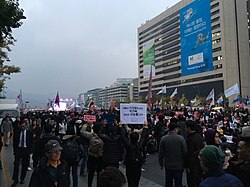
The Rise of the Candlelight Protests
The movement became widely known as the Candlelight Protests (chotbul jiphoe). These demonstrations were characterized by peaceful gatherings where participants used candles as a symbol of their demand for justice. The primary goals of the protesters were the resignation of President Park Geun-hye, the punishment of Choi Soon-sil, and the dissolution of the Liberty Korea Party.
A Timeline of Mass Mobilization
The scale of the protests grew exponentially over several months, moving from tens of thousands to millions of participants.
- October 2016: The first candlelight protest was held on October 29, with an estimated 20,000 participants.
- November 2016: Participation surged. By November 28, an estimated 1.9 million people participated in a nationwide anti-president rally.
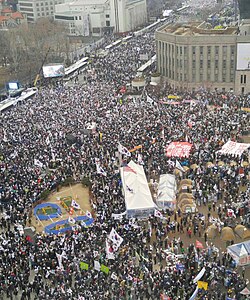
- December 2016: One of the largest demonstrations in the country's history occurred on December 3, with an estimated 2.3 million people taking to the streets. This included massive gatherings in Seoul, Busan, and Gwangju. On December 24, a "Santa Rally" saw 550,000 people calling for the President's removal.
- January 2017: Protesters continued to demand the President's removal and called for answers regarding the Sewol ferry sinking, a tragedy that left over 300 dead. In a symbolic gesture on January 7, protesters released yellow balloons and blew out their candles to highlight the mystery surrounding the President's seven-hour absence during the ferry disaster.
- February 2017: As the rallies reached their 100th day, 400,000 people gathered at Gwanghwamun Plaza. Tensions rose following the arrest of Samsung vice-chairman Lee Jae-Yong on bribery charges related to the scandal.
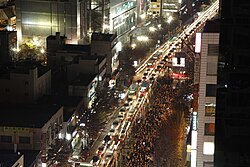
Counter-Protests and Rivalry
The movement was not without opposition. Pro-Park groups organized rival rallies, often characterized by the waving of South Korean flags. These groups argued against the impeachment and criticized media coverage, claiming it was biased against conservative views. By early 2017, both sides held massive, competing demonstrations in central Seoul, often separated by heavy police perimeters.
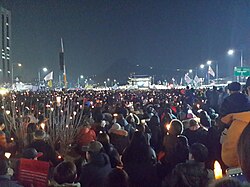
The Impeachment and Political Outcome
The legal process for removing a president moved through the National Assembly to the Constitutional Court of Korea. On December 9, 2016, the National Assembly passed an impeachment motion with 234 votes—well above the required two-thirds majority. This included 62 members of Park's own Saenuri Party.
On March 10, 2017, the Constitutional Court officially upheld the impeachment, removing Park Geun-hye from office. This led to new presidential elections in May 2017, in which Moon Jae-in was elected President.
Summary of Protest Statistics
| Date | Anti-Park (Organiser Claim) | Anti-Park (Police Estimate) | Pro-Park (Organiser Claim) |
|---|---|---|---|
| Oct 29, 2016 | 50,000 | 12,000 | - |
| Nov 28, 2016 | - | 1,900,000 | - |
| Dec 3, 2016 | 2,300,000 | 424,000 | - |
| Jan 14, 2017 | 146,700 | - | 1,200,000 |
| Feb 11, 2017 | 750,000 | - | 2,100,000 |
Key Facts
- Duration: The protests lasted approximately 6 months and 4 weeks (October 26, 2016 – May 24, 2017).
- Primary Cause: Corruption and the 2016 South Korean political scandal.
- Major Result: The impeachment and removal of President Park Geun-hye.
- Political Shift: Moon Jae-in was elected President following the May 2017 elections.
- Casualties: The protests resulted in 55 injured protesters and 4 injured officers.
Frequently Asked Questions
What were the main goals of the protesters?
The protesters primarily sought the resignation of President Park Geun-hye, the legal punishment of Choi Soon-sil, and the dissolution of the Liberty Korea Party.
How did the Constitutional Court affect the protests?
The Constitutional Court was the final legal authority. After reviewing the impeachment motion, the Court ruled the impeachment valid on March 10, 2017, which officially removed Park Geun-hye from office and ended the weekly protests.
Who were the main organizers of the candlelight rallies?
The protests were organized by the Organizing Committee for People's Candlelight Demonstrations in Korea, which included various groups such as the KCTU, KPL, KTU, PSPP, FKTU, the Democratic Party, the Green Party, the Labor Party, and the Justice Party.
Were there any military plans regarding the protests?
In July 2018, it was revealed that the Defense Security Command had developed plans to declare martial law and use military force—including tanks and special forces—to crack down on protesters if the impeachment had not been upheld.
What was the significance of the yellow balloons?
During the January 7, 2017, protest, hundreds of yellow balloons were released as a symbolic gesture. This was done to demand clarity regarding the President's seven-hour absence during the Sewol ferry sinking.