2015 UEFA European Under-21 Championship Format and Group Stage Results
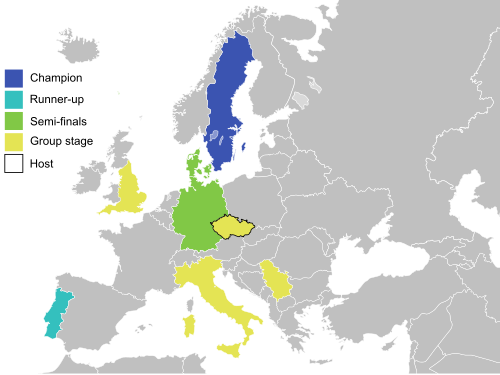
The 2015 UEFA European Under-21 Championship featured a competitive structure designed to determine the best young talent in Europe. Eight finalist teams competed for the title, with the tournament also serving as a critical qualifying event for the 2016 Summer Olympics.
The competition began with the eight teams divided into two groups of four. To ensure a balanced distribution, seeding was applied: the Czech Republic, as the host nation, was seeded in Group A, while England, the highest-ranked team according to the UEFA coefficient ranking (a system used to rank national teams based on their performance in previous tournaments), was seeded in Group B.
Tournament Structure and Progression
The group stage utilized a round-robin system, meaning every team in a group played against every other team exactly once. The primary objective for each nation was to finish in the top two of their respective group to secure a place in the semi-finals.
UEFA released the provisional schedule on November 10, 2014, and confirmed the final dates on December 2, 2014. All matches were scheduled according to Central European Summer Time (UTC+02:00). Beyond the championship trophy, the four teams that advanced from the group stage earned qualification for the Olympic football tournament.
Tie-Breaking Criteria
In the event that two or more teams finished the group stage with an equal number of points, UEFA employed a strict set of tie-breaking rules to determine the rankings:
- Higher number of points obtained in matches played between the tied teams.
- Superior goal difference resulting from matches played between the tied teams.
- Higher number of goals scored in matches played between the tied teams.
If teams remained tied after these three steps, the process was reapplied exclusively to the matches between the teams in question. If a decision was still not reached, the following criteria were used:
- Superior goal difference across all group matches.
- Higher number of goals scored across all group matches.
- Position in the UEFA under-21 coefficient ranking used for the final draw.
A special provision existed for teams tied after their final group match: if only two teams were equal according to criteria 1–5, their ranking was decided by a penalty shoot-out.
Group Stage Performance
Group A Results
Group A saw Denmark emerge as the leader, securing their spot in the knockout stage and Olympic qualification. Germany followed in second place, while the hosts, Czech Republic, and Serbia failed to advance.
| Pos | Team | Pld | W | D | L | GF | GA | GD | Pts |
|---|---|---|---|---|---|---|---|---|---|
| 1 | Denmark | 3 | 2 | 0 | 1 | 4 | 0 | +4 | 6 |
| 2 | Germany | 3 | 1 | 2 | 0 | 5 | 2 | +3 | 5 |
| 3 | Czech Republic | 3 | 1 | 1 | 1 | 6 | 3 | +3 | 4 |
| 4 | Serbia | 3 | 0 | 1 | 2 | 1 | 7 | -6 | 1 |
Group B Results
Group B was tightly contested, with Portugal taking the top spot. Sweden secured the second qualifying position, narrowly edging out Italy and England.
| Pos | Team | Pld | W | D | L | GF | GA | GD | Pts |
|---|---|---|---|---|---|---|---|---|---|
| 1 | Portugal | 3 | 1 | 2 | 0 | 2 | 1 | +1 | 5 |
| 2 | Sweden | 3 | 1 | 1 | 1 | 4 | 3 | +1 | 4 |
| 3 | Italy | 3 | 1 | 1 | 1 | 4 | 3 | +1 | 4 |
| 4 | England | 3 | 1 | 0 | 2 | 4 | 6 | -2 | 3 |
Key Facts
- Host Nation: Czech Republic (seeded in Group A).
- Top Seed: England (seeded in Group B based on UEFA coefficient ranking).
- Olympic Qualification: The top two teams from each group (Denmark, Germany, Portugal, and Sweden) qualified for the 2016 Summer Olympics.
- Group A Winner: Denmark (6 points).
- Group B Winner: Portugal (5 points).
Frequently Asked Questions
How were the teams seeded for the tournament?
The Czech Republic was seeded in Group A as the host nation, and England was seeded in Group B as the highest-ranked team in the UEFA coefficient ranking.
Which teams qualified for the 2016 Summer Olympics?
The four teams that advanced to the semi-finals—Denmark, Germany, Portugal, and Sweden—qualified for the Olympic football tournament.
What happened if teams were tied on points in the group stage?
UEFA used a series of tie-breakers, starting with head-to-head points, then head-to-head goal difference, and head-to-head goals scored. If still tied, overall group goal difference and goals scored were considered, followed by the UEFA coefficient ranking.
Was there a penalty shoot-out in the group stage?
A penalty shoot-out would only have occurred if exactly two teams were tied after all other criteria (1–5) were applied and they had met in the final match of the group stage.
What was the format of the group stage?
The eight finalists were split into two groups of four, playing a round-robin system where each team played every other team in their group once.