2014 FIFA World Cup Brazil: A Comprehensive Tournament Review
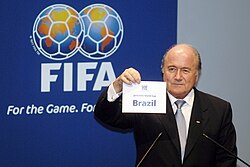
The 2014 FIFA World Cup was a landmark sporting event hosted by Brazil, bringing together 32 national teams from five confederations. Held from June 12 to July 13, the tournament celebrated the passion of football in its spiritual home, featuring 64 matches across 12 iconic host cities.
From the high-energy opening ceremony to the dramatic final in Rio de Janeiro, the event was marked by stunning individual performances and unexpected upsets. While the host nation dreamed of a sixth title, the tournament ultimately saw a European powerhouse claim the trophy.
Key Facts
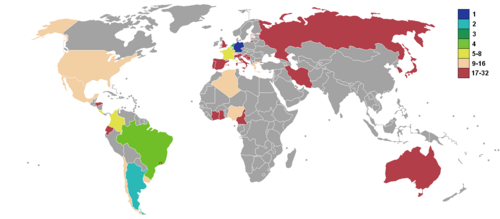
- Champion: Germany (their 4th title)
- Runner-up: Argentina
- Top Scorer: James Rodríguez (6 goals)
- Best Player: Lionel Messi
- Total Attendance: 3,429,873 spectators
- Total Goals: 171 (average of 2.67 per match)
- Official Mascot: Fuleco
Tournament Structure and Participation
The competition began with a group stage where 32 teams were divided into eight groups (A through H). Teams competed in a round-robin format, with the top two from each group advancing to the knockout stage. Tie-breaking criteria included total points, goal difference, and goals scored.
The group stages provided several surprises, most notably in Group D, where Costa Rica emerged as the leader over traditional powers like Italy and England. Meanwhile, the defending champions, Spain, suffered a shocking early exit after finishing third in Group B behind the Netherlands and Chile.
The Road to the Final
The knockout phase intensified the competition. Germany's path to victory was highlighted by a historic 7-1 semi-final demolition of the host nation, Brazil. Argentina reached the final after a tense penalty shootout against the Netherlands in the semi-finals.
The final match took place on July 13 at the Estádio do Maracanã. After a scoreless 90 minutes, Mario Götze scored in the 113th minute of extra time to secure a 1-0 victory for Germany over Argentina.
Venues and Infrastructure
Brazil utilized 12 stadiums to accommodate the massive influx of fans and athletes. The Estádio do Maracanã in Rio de Janeiro served as the crown jewel, hosting the final with a capacity of 74,738.
| City | Stadium | Capacity |
|---|---|---|
| Rio de Janeiro | Estádio do Maracanã | 74,738 |
| Brasília | Estádio Nacional | 69,432 |
| São Paulo | Arena Corinthians | 63,321 |
| Fortaleza | Estádio Castelão | 60,348 |
| Belo Horizonte | Estádio Mineirão | 58,259 |
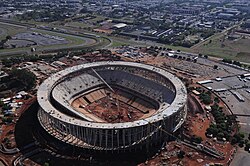
Infrastructure development was a point of significant discussion. The Estádio Nacional in Brasília, for example, saw its costs balloon from an original budget of US$300 million to US$900 million, making it the second-most expensive stadium in the world at the time.
Symbols, Technology, and Marketing
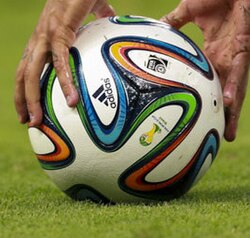
The tournament introduced the Brazuca, the official match ball designed for high visibility and aerodynamic stability.
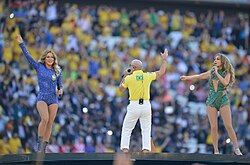
The opening ceremony at the Arena de São Paulo featured global stars including Jennifer Lopez, Pitbull, and Claudia Leitte, setting a festive tone for the event.
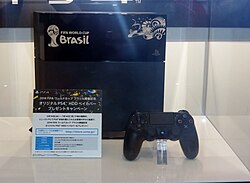
Commercial support was vast, with FIFA partners such as Adidas, Coca-Cola, Visa, and Sony providing significant sponsorship. However, the event was not without friction; widespread anti-World Cup demonstrations occurred, with protesters using the slogan "Não vai ter Copa" (There will be no Cup) to voice concerns over spending and social issues.
![Anti-World Cup demonstration on the opening day; "Não vai ter Copa" ("There will be no [World] Cup") was a common slogan from protesters](/images/07/03/0703ec358f24f489dac61f1e6e22280c6f4b256f27cf1bdd37e1f3b156b93c7a.jpg)
Individual Awards and Honors
At the conclusion of the tournament, several players were recognized for their exceptional contributions. Lionel Messi received the Golden Ball as the best player, while James Rodríguez of Colombia took home the Golden Boot for his six goals.
- Golden Ball: Lionel Messi
- Golden Boot: James Rodríguez
- Golden Glove: Manuel Neuer
- Best Young Player: Paul Pogba
- Fair Play Trophy: Colombia
Frequently Asked Questions
Who won the 2014 FIFA World Cup?
Germany won the tournament, defeating Argentina 1-0 in the final to claim their fourth World Cup title.
Who was the top goalscorer of the tournament?
James Rodríguez of Colombia was the top scorer, netting a total of 6 goals.
Which stadium hosted the final match?
The final was held at the Estádio do Maracanã in Rio de Janeiro.
What was the official match ball called?
The official match ball used during the 2014 tournament was called the Brazuca.
How many teams participated in the 2014 World Cup?
A total of 32 teams from five different confederations participated in the event.