1986 Asian Games: Seoul's Landmark Sporting Event
The 10th Asian Games, officially known as the X Asiad and commonly referred to as Seoul 1986, represented a pivotal moment in international sports. Held in Seoul, South Korea, from 20 September to 5 October 1986, the event served as a critical precursor to the 1988 Summer Olympics, with many of the venues and facilities used during the Games serving as test sites for the upcoming Olympic Games.
While Seoul had originally been scheduled to host the 1970 Games, security threats from neighboring North Korea forced the city to relinquish hosting duties to Bangkok, Thailand. However, by 1986, Seoul emerged as the sole bidding city after Baghdad, Iraq, and Pyongyang, North Korea, withdrew from the process.
Key Facts
- Host City: Seoul, South Korea
- Dates: 20 September – 5 October 1986
- Participating Nations: 27
- Total Athletes: 4,839
- Events: 296 events across 25 sports
- Official Mascots: Hodori (tiger) and Gomdoori (black bear)
Development and Mascots
To represent the spirit of the Games, organizers introduced two official mascots: Hodori, a stylized Amur tiger, and Gomdoori, an Asian black bear. Designed by Kim Hyun and Lee Yun Soo respectively, these characters were intended to portray the friendly and hospitable traditions of the Korean people. Interestingly, these mascots were also utilized for the 1988 Summer Olympics and Paralympics.
Venues and Facilities
The 1986 Games utilized a wide array of facilities across South Korea to accommodate the diverse range of sports. The Jamsil Olympic Stadium served as the main venue for ceremonies, athletics, and the football finals.
Major Competition Venues
- Jamsil Arena: Basketball
- Jamsil Indoor Swimming Pool: Diving, Swimming, and Water polo
- Seoul Olympic Gymnastics Arena: Badminton and Gymnastics
- Olympic Tennis Center: Tennis
- Taenung International Shooting Range: Shooting
- Gwacheon Equestrian Park: Equestrian
Participation and Political Context
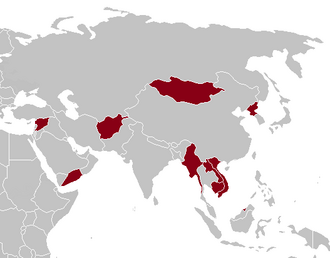
The Games were marked by significant geopolitical dynamics. Several nations boycotted the event, including North Korea and its allies: Mongolia, Vietnam, Laos, Afghanistan, and South Yemen. Additionally, Burma and Syria did not participate due to financial reasons, and Brunei Darussalam was absent due to a 40-day period of national mourning following the death of the Sultan's father.
In contrast, the People's Republic of China—the only participating country from the Eastern Bloc—sent a high-profile delegation and ultimately finished at the top of the medal table. This participation was notable as China was set to host the subsequent Games in Beijing.
The event was also shadowed by a security incident; just days before the opening, a North Korean spy detonated a bomb at Gimpo International Airport, resulting in five fatalities, including a South Korean delegate.
Summary of Games Statistics
| Category | Details |
|---|---|
| Official Name | 10th Asian Games (X Asiad) |
| Opening Ceremony | Opened by President Chun Doo-hwan |
| Closing Ceremony | Closed by Fahad Al-Ahmed Al-Jaber Al-Sabah |
| Torch Lighters | Jang Jae-keun and Park Mi-sun |
| Total Sports | 25 |
| Total Events | 296 |
Frequently Asked Questions
Why were the 1986 Asian Games considered a test event?
The Games were used to test the venues and facilities that would later be utilized for the 1988 Summer Olympics.
Which country finished first in the medal table?
The People's Republic of China finished at the top of the medal table.
Who were the official mascots of the Seoul 1986 Games?
The mascots were Hodori the tiger and Gomdoori the black bear.
How many nations participated in the 1986 Games?
A total of 27 National Olympic Committees participated in the event.
What was the significance of the Jamsil Olympic Stadium?
It served as the main venue for the opening and closing ceremonies, as well as athletics and the football finals.